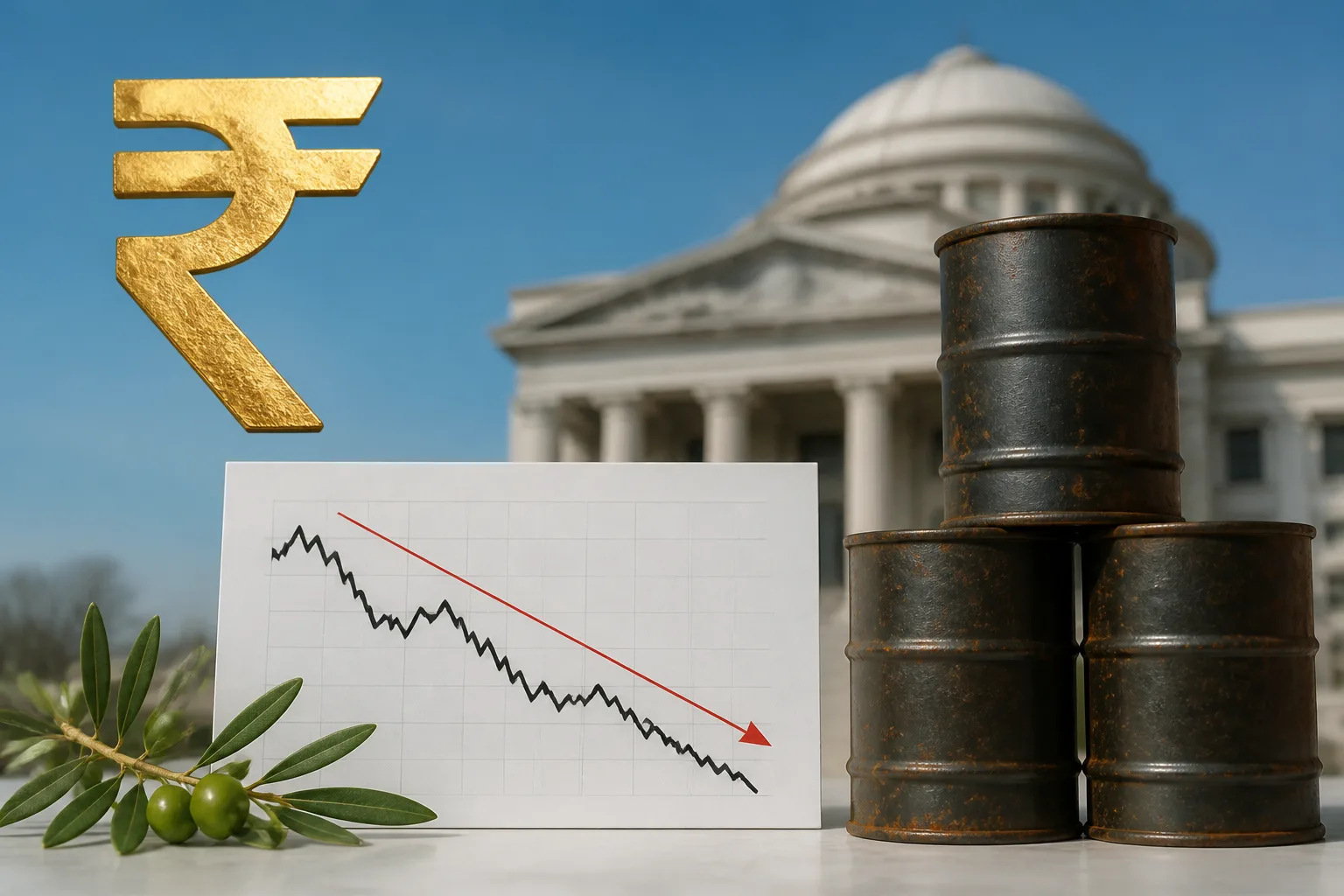
Rupee Gains as Oil Prices Drop, Backed by RBI Measures and US-Iran Peace Deal
The Indian rupee rose 0.7 % to ₹94.4625 per U.S. dollar on Monday, its strongest level in seven weeks. The move followed a sharp decline in crude oil prices after Washington and Tehran announced that they had reached an initial agreement to halt their conflict and reopen the Strait of Hormuz.
Oil prices fell as the market reacted to the news of a U.S.‑Iran peace framework. Brent crude futures dropped more than 4 % on Thursday, and U.S. crude fell below $80 a barrel. The lower cost of oil has eased pressure on India’s import bill and its current‑account deficit, which in turn supports the rupee.
The rupee was the second‑best performing Asian currency that day, trailing only the Indonesian rupiah. Its year‑to‑date loss of about 5.6 % has narrowed, and the currency is roughly 2.5 % above the all‑time low of near ₹97 per dollar that it hit about a month ago.
Reserve Bank of India (RBI) actions have also helped improve the rupee’s outlook. The RBI has introduced a swap scheme that allows non‑resident Indians (NRIs) to earn higher returns on U.S. dollar deposits while the bank bears the hedging cost. The scheme is expected to attract billions of dollars in foreign currency deposits.
Economist Gaura Sen Gupta of IDFC First Bank said the drop in oil prices reinforces the RBI’s efforts to support the rupee. He expects the currency to reach the ₹93‑94 per dollar range by September, aided by a revival in NRI inflows.
The RBI’s measures have also shifted analysts’ expectations for India’s balance of payments. Most now see a marginal surplus for the current fiscal year, compared with earlier projections of a deficit of up to $70 billion.
Until recently, the rupee was viewed as one of the most vulnerable Asian currencies, largely because of high oil prices and expectations of continued losses. Some market participants had speculated that the RBI might raise its policy rate to support the currency, following moves by the central banks of Indonesia and the Philippines.
The potential for a rupee rally depends on how far the RBI allows the currency to strengthen. Hemant Mishr, founder and CIO of Singapore‑based S Cube Capital, said that if the peace deal holds and oil prices remain low, the rupee could move toward ₹92 per dollar by September. He added that the currency remains undervalued and that investor withdrawals of roughly $30 billion from Indian equities during the U.S.‑Iran conflict should begin to reverse.
The extent of any rally will also be influenced by the RBI’s use of the rupee’s strength to manage its sizeable foreign‑exchange forward book. The central bank may choose to let the currency appreciate to a level that supports its broader policy objectives.
In summary, the rupee’s recent gains are the result of a combination of lower oil prices, a supportive RBI policy framework for NRI deposits, and optimism about the U.S.‑Iran peace deal. The currency is now trading near its best level in almost two months, and analysts expect further appreciation if the peace agreement holds and oil prices stay subdued.
The next few weeks will be crucial for the rupee as the RBI monitors the impact of the new deposit scheme, the evolving oil market, and the stability of the U.S.‑Iran agreement. Investors and policymakers will be watching closely to see whether the rupee continues its upward trajectory or stabilises at a new equilibrium.