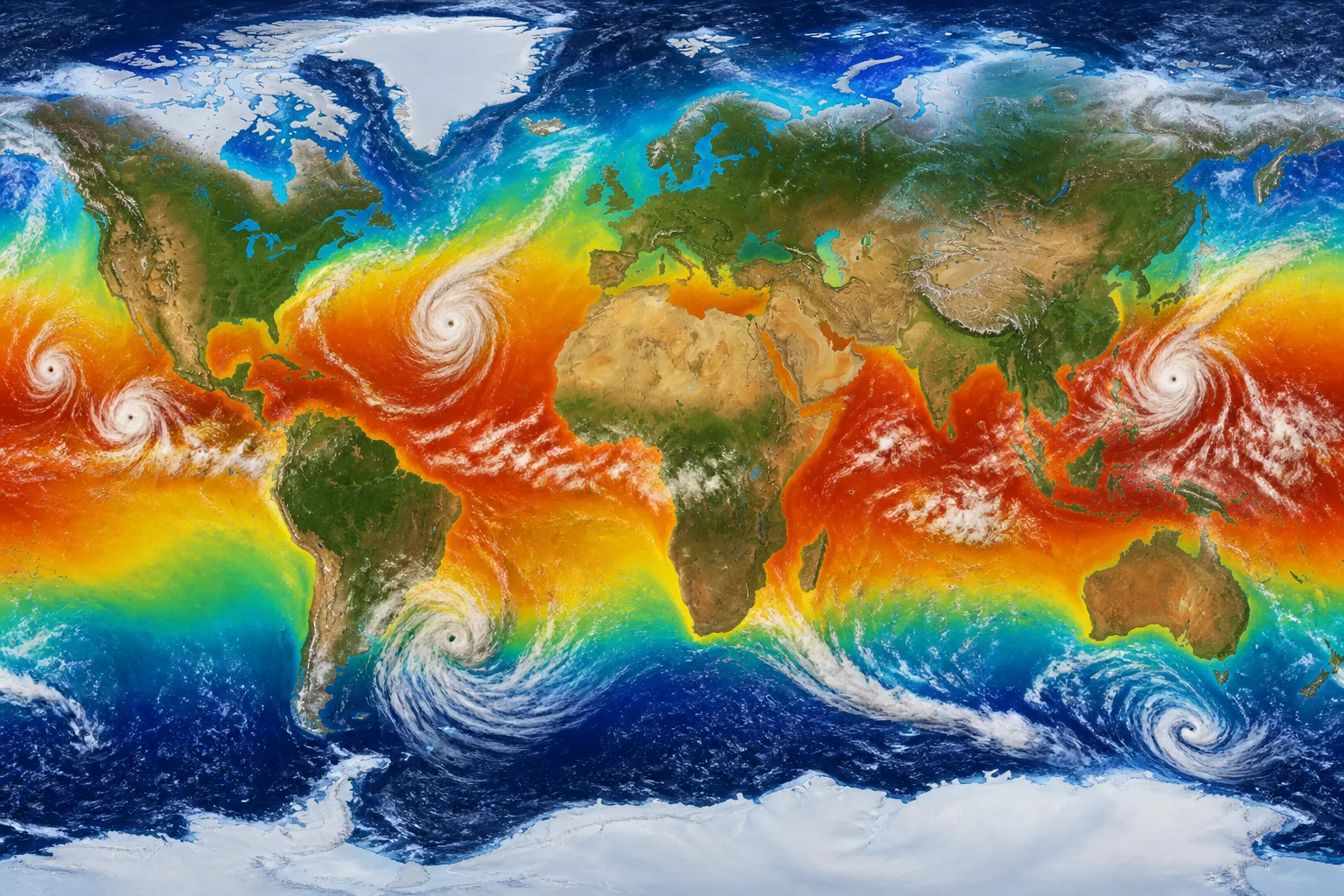
August 2026 Sets New Global Temperature Record, Fueled by El Nino and Rising Sea Surface Heat
In a blistering turn of events, the world’s average surface air temperature for August 2026 hit a scorching 62.5 °F (16.94 °C), the highest ever recorded for the month. The Copernicus Climate Change Service (C3S) announced the figure on September 10, 2026, and it makes August a joint‑hottest month worldwide—tied with July 2023—and the first month since January 2025 to exceed the 1.5 °C (2.7 °F) ceiling set by the Paris Agreement.
C3S, part of the European Union’s Copernicus Programme, drew on observations that stretch back to 1940. Its August average was 1.65 °C above the 1850‑1900 pre‑industrial baseline, a level that the planet has not reached since November 2025. The bulletin called the month “remarkable” and noted that the record sits squarely within a broader pattern of warming driven by long‑term human‑caused greenhouse‑gas emissions.
A key spark was the ongoing El Niño, which has intensified across the central and eastern equatorial Pacific. El Niño, a natural climate oscillation that heats sea surface temperatures, can push global averages up temporarily. However, the C3S bulletin clarified that El Niño “does not explain the record‑breaking warmth on its own; it adds to the background trend of warming.”
Sea surface temperatures followed suit. On August 22, the daily global average between 60° S and 60° N hit 69.98 °F (21.13 °C), the highest ever recorded. That surpassed the previous mark of 69.96 °F set during the last El Niño in early 2024. It marked the second consecutive month to set a new monthly maximum.
In the United States, NOAA reported that the meteorological summer (June‑August) was the warmest on record for the contiguous 132‑year climate archive. The average summer temperature exceeded the previous highs of 1936 and 2021 by 0.4 °F (0.22 °C). NOAA also noted that August alone recorded the highest average temperature for the month in the U.S. since 1895.
Western Europe faced its hottest summer on record, outpacing the notorious 2003 heatwave. Early, persistent, and intense heatwaves sparked widespread wildfires and severe drought. River levels in several major waterways fell sharply, disrupting water supplies, irrigation, and energy production across multiple countries. The European Climate Assessment–Hadley (ECA‑Had) described the summer as “much drier than average” in western and central Europe, southern Scandinavia, and southeastern Europe.
These new records reinforce the scientific consensus that the 1.5 °C limit is being exceeded. The Paris Agreement’s goal to keep global warming well below 2 °C—and preferably 1.5 °C—is based on averages over twenty‑year periods. The C3S data show that the world has already surpassed the 1.5 °C threshold, a milestone first reached in 2024.
While El Niño events can cause short‑term spikes, climate scientists stress that the long‑term trend is driven by anthropogenic greenhouse‑gas emissions. The 2026 record is a stark reminder that the planet’s climate system is under increasing stress.
The record‑setting August 2026 underscores the urgency of climate mitigation and adaptation, and it highlights the importance of continued monitoring by services such as C3S and NOAA. Their data equip policymakers, businesses, and communities with the evidence needed to respond to a warming world.
At present, August 2026 remains the warmest month on record, with global temperatures 1.65 °C above pre‑industrial levels. Ongoing monitoring will reveal whether the trend continues into 2027 and beyond.